1. Calculating Glass Weight
Accurate calculation of glass weight is essential for determining hinge types, lifting capacity, structural load-bearing, and transportation costs. The standard density of flat glass is considered to be 2500 kg/m³.
Simple Weight Calculation Formula:
Weight (kg) = Area (m²) × Thickness (mm) × 2.5 (kg)
Unit Weight Table for Common Thicknesses:
| Glass Thickness (mm) | Weight (kg/m²) |
|---|---|
| 4 | 10 |
| 6 | 15 |
| 8 | 20 |
| 10 | 25 |
| 12 | 30 |
| 15 | 37.5 |
| 19 | 47.5 |
Note: In Insulating Glass Units (IGU), the weight of both panes is summed, and the weight of the spacer and butyl sealant (approx. 1 to 2 kg/m²) is added to the total.
2. Dimensional Tolerances and Cutting Standards
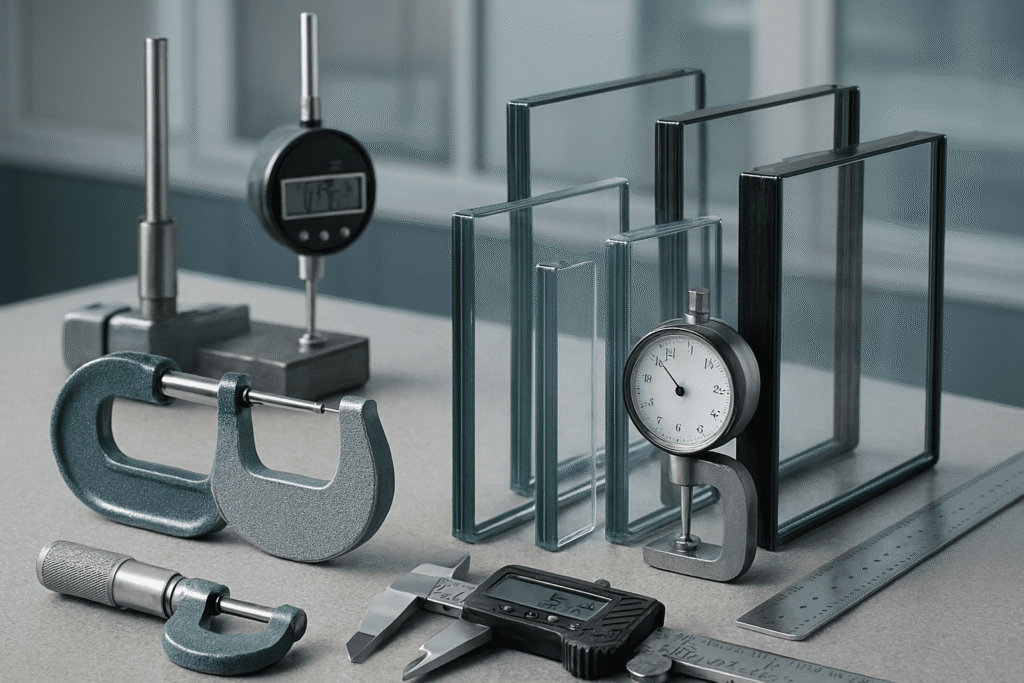
In engineered production, dimensional accuracy reflects the functional quality of CNC machinery. Our products are manufactured according to national and international standards.
A) Length and Width Tolerance (Cutting and Edging):
| Glass Size (mm) | Permissible Tolerance (mm) |
|---|---|
| Up to 1000 mm | ±1 mm |
| 1000–2000 mm | ±1.5 mm |
| Over 2000 mm | ±2 mm |
B) Diagonal Tolerance:
The difference between the two diagonals must not exceed the following limits:
- For small units: Less than 2 mm
- For jumbo sizes: Less than 4 mm
C) Bow and Warp Tolerance:
- Overall Bow: Max 0.3% of length.
- Roller Wave Distortion: Max 0.15 mm per 300 mm.
3. Glass Thickness Standards (Thickness Tolerance)
| Nominal Thickness (mm) | Permissible Variation (mm) |
|---|---|
| 3–6 mm | ±0.2 |
| 8–12 mm | ±0.3 |
| 15–19 mm | ±0.5 to ±1.0 |
“Accuracy is our commitment.” All outgoing glass is inspected by quality control engineers to ensure products are delivered with the minimum margin of error.
Mechanical Strength of Laminated Glass
1. SGP (SentryGlas Plus) Interlayer:
This interlayer ensures that in the event of breakage, the panel does not collapse and continues to support its weight and lateral loads. SGP remains rigid even at 50°C. (Ideal for: glass stairs, large cantilevers, high-rise facades).
2. EVA (Ethylene-Vinyl Acetate) Interlayer:
The primary advantage of EVA is high moisture resistance. Due to its cross-link structure, it rarely undergoes delamination. (Ideal for: pools, humid environments, decorative laminates).
3. PVB (Polyvinyl Butyral) Interlayer:
Common and economical for safety glass. It absorbs impact energy and prevents shard dispersal. In structural calculations, it is primarily a safety component. (Ideal for: standard windows, internal partitions).
Laminated Glass Performance Comparison Table:
| Technical Characteristic | PVB (Standard) | EVA (Moisture Res.) | SGP (SentryGlas) | Reference Standard |
|---|---|---|---|---|
| Stiffness and Rigidity | Low (Flexible) | Medium | Very High (100x PVB) | ASTM D638 |
| Tensile Strength | 20–25 MPa | 18–22 MPa | 35–50 MPa | ISO 527-3 |
| Post-Breakage Capacity | Layer collapse | Relative retention | Excellent Integrity | EN 12600 |
| Edge Stability (Moisture) | Medium (Risk of bubbles) | Very Excellent (Cross-link) | Excellent (No Delam.) | ANSI Z97.1 |
| Specialized Application | Windows & General Safety | Humid Areas / Decorative | Stairs, Facades & Structural | ASTM E1300 |
Key Parameters Influencing Stability:
Base Glass Type:
- Annealed Laminated: Shards remain in place after breakage.
- Tempered Laminated: 5x additional strength; mandatory for load-bearing surfaces.
Impact Resistance Class (EN 12600):
Class 1(B)1 = No penetration after a simulated human body impact from maximum height.
Load Sharing Factor:
PVB acts as a bonding layer at 20–30°C; for high-temperature or long-term loads, SGP (SentryGlas) is utilized, offering ~100 times the stiffness of PVB.
Wind and Snow Loads:
Thick laminated structures (≥12 mm) are engineered for static snow loads and dynamic wind loads at heights exceeding 50 meters.
“All load-bearing and thickness analyses are performed via Finite Element Analysis (FEA) software in accordance with National Building Regulations and ASTM standards.”
4. Structural Strength of Tempered Glass
In accordance with EN 12150-1 and ASTM E1300 calculation methods.
| Thickness (mm) | Weight (kg/m²) | Char. Bending Strength fb,k (MPa) | Rel. Bending Stiffness | Surface Comp. Stress fb,d (MPa) | Thermal Shock Resistance ΔT |
|---|---|---|---|---|---|
| 4 | 10 | ≥ 120 | 1 | ≥ 90 (90–120) | 200–220°C |
| 6 | 15 | ≥ 120 | 3.4 | ≥ 90 (90–120) | 220–250°C |
| 8 | 20 | ≥ 120 | 8 | ≥ 90 (90–120) | 220–250°C |
| 10 | 25 | ≥ 120 | 15.6 | ≥ 90 (90–110) | 250°C |
| 12 | 30 | ≥ 120 | 27 | ≥ 90 (90–110) | 250°C |
| 15 | 37.5 | ≥ 120 | 52.7 | ≥ 90 (90–100) | 250°C |
| 19 | 47.5 | ≥ 120 | 107 | ≥ 90 (90–100) | 250°C |
Bending Strength
The characteristic bending strength of tempered glass, according to the EN 12150 standard, is 120 MPa. This value is used as the reference (Characteristic Strength) and is defined independently of the glass thickness. In structural design, the design bending strength is reduced by applying safety factors, typically resulting in a value of approximately 80 MPa. This value is utilized in load-bearing calculations and stress control in accordance with Eurocode and ASTM E1300 logic.
While increasing the glass thickness enhances the panel’s overall load-bearing capacity, it does not alter the inherent bending strength of the glass material itself.
Surface Compressive Stress
According to the EN 12150-1 standard, the minimum surface compressive stress of tempered glass must be greater than 90 MPa. This stress is a result of the controlled thermal tempering process and is the primary factor that increases the glass’s resistance to breakage.
In industrial production, the actual surface compressive stress typically ranges between 90 and 120 MPa, depending on thickness, edging quality, thermal uniformity, and furnace type. Thicker glass often achieves higher compressive values, although the standard requirement remains at a minimum of 90 MPa.
Thermal Shock Resistance
Thermal shock resistance refers to the ability of the glass to withstand sudden temperature differentials between its surfaces. Tempered glass can endure a temperature difference of approximately 200°C to 250°C without failure.
In thinner units, due to faster heat transfer and higher edge sensitivity, the reliable thermal shock value is usually at the lower end of this range. For units 10 mm and thicker, practical resistance reliably reaches 250°C. Note that this value represents tolerance for sudden temperature changes, not a continuous operating temperature.
The ASTM E1300 standard does not provide a fixed value for wind load or permissible pressure. Glass load-bearing must be calculated based on panel dimensions, aspect ratio, support type, and safety factors. Therefore, project-specific calculations are required to determine the final permissible load.
Quality and Compliance Tests:
Fragmentation Test (EN 12150): Requires ≥ 40 particles within a 50×50 mm area upon breakage.
Heat Soak Test (HST): Performed to mitigate the risk of spontaneous breakage caused by Nickel Sulfide (NiS) inclusions.
5. Standards for Insulating Glass Units (IGU)
| Application | Recommended Configuration (mm) | Total Thickness (mm) | Spacer (mm) | Sealant Depth (mm) | Max Size (mm) | Min Size (mm) |
|---|---|---|---|---|---|---|
| Standard Residential | 4 + 12 + 4 | 20 | 12 | 3–5 | 1500 × 2500 | 200 × 300 |
| Luxury Residential | 6 + 10 + 4 | 20 | 10 | 4–5 | 1800 × 2800 | 200 × 300 |
| Commercial / Display | 6 + 12 + 6 | 24 | 12 | 5–7 | 2200 × 3200 | 300 × 300 |
| Acoustic (Semi-Industrial) | 8 + 12 + 6 | 26 | 12 | 6–8 | 2400 × 3500 | 300 × 300 |
| Triple Glazed | 4 + 12 + 4 + 12 + 4 | 36 | 12 + 12 | 5–7 | 1800 × 2800 | 300 × 300 |
| Jumbo (High-Rise) | 10 + 16 + 10 | 36 | 16 | 8–10 | 3000 × 5000 | 400 × 400 |
Technical Notes:
- Dual Sealing: Primary Butyl + Secondary Silicone/Polysulfide for maximum durability.
- Dew Point: According to industry standards for preventing internal condensation, the dew point inside the IGU must typically be lower than -40°C. High-quality manufacturers can achieve -50°C to -60°C.
- Argon Gas: >90% concentration to reduce U-value and optimize thermal insulation.
6. Optical and Thermal Analysis (Low-E Glass)
Coating Type Visible Light Trans. (VLT) U-Value (W/m²K) SHGC UV Blocking Single Silver 70–75% 1.6–1.8 0.45–0.55 80% Double Silver 60–65% 1.3–1.5 0.30–0.40 92% Triple Silver 50–55% 1.1–1.2 0.20–0.25 98%
7. Bulletproof and Attack Resistance
Class Weapon / Threat Thickness (mm) Weight (kg/m²) Application BR2 9mm Handgun 20–24 55 Jewelry Stores BR4 .44 Magnum 32–38 85 Banks BR6 AK-47 45–55 125 Military / Embassy BR7 Sniper Rifle 75–85 195 Safe Rooms
8. Fire-Resistant Glass Standards
Class Performance Duration (min) Thickness (mm) E Flame and smoke blocking 30 / 60 / 90 6–12 EW Flame blocking and radiation control 30 / 60 15–20 EI Flame + Full Insulation 60 / 90 / 120 25–50
9. Smart Glass (PDLC) Technical Table
| Parameter | Specifications |
|---|---|
| Operating Voltage | 48–60 VAC |
| Power Consumption | 5–7 W/m² (ON State) |
| Response Time | < 100ms |
| Visible Light Transmission (VLT) | > 78% (ON State) |
| Haze / Opacity | > 90% (OFF State) |
| Viewing Angle | 160° |
| Switching Life | Greater than 3, 5, or 10 million cycles (depending on PDLC film type, operating voltage, frequency, ambient temperature, etc.) |
10. Spandrel Glass Technical Table
| Parameter | Standard / Description |
|---|---|
| Ink Type | Ceramic Frit (Heat Resistant) |
| Color Stability | Grade A (UV / Acid Rain Resistant) |
| Production Process | Tempered or Heat Strengthened (HS) |
| Thickness | 4–19 mm |
| Adhesion Test | ASTM D3359 (Highest Adhesion Grade) |
| Application | Covering spandrel areas (inter-floor) and other non-transparent facade sections |
11. Comparison Table – Low-E Glass Types
| Feature | Hard Coat Low-E (Online) | Soft Coat Low-E (Offline) |
|---|---|---|
| Production | During the float process | Magnetron Sputtering after glass production |
| Emissivity | 0.15–0.20 | 0.03–0.10 |
| U-Value (W/m²K) | ~2.0–2.4 | ~1.1–1.5 |
| Scratch Resistance | Very High | Sensitive (must be sealed inside IGU) |
| Appearance | Slight Tint | Ultra-Clear |
| Usability | Single-pane compatible | Must be internal pane of an IGU |
12. Technical Comparison of HS Glass (Heat Strengthened)
| Parameter | Annealed Glass | HS (Heat Strengthened) | FT (Fully Tempered) |
|---|---|---|---|
| Mechanical Strength | 1x | 2x | 4–5x |
| Surface Stress | < 1,500 psi | 3,500–7,500 psi | > 10,000 psi |
| Breakage Pattern | Large sharp shards | Large fragments held in frame | Small blunt fragments |
| Spontaneous Breakage | None | Very Low | Possible (HST recommended) |
| Main Application | General Glazing | Spandrels / Facades | Doors / Partitions |
“Technology at the Service of Safety and Beauty”
At Arshia Jam Industrial Complex, utilizing advanced fully automatic European machinery and specialized testing laboratories, we are committed to manufacturing products that exceed mandatory standards. Each glass batch comes with a Personalized Technical ID Certificate, confirming material quality and authenticity.